A pillar of performance, safety and responsible innovation
Material characterization is a crucial step in industrial development. It involves detailed analysis of a material’s mechanical, thermal and physico-chemical properties to understand how it reacts, ages and behaves in its final application. Far more than a series of tests, it is a decision-making tool essential for designing products that are high-performing, safe, durable and increasingly responsible.
Guarantee performance, reliability and service life
The primary goal of characterization is to objectively evaluate a material’s performance by measuring key properties:
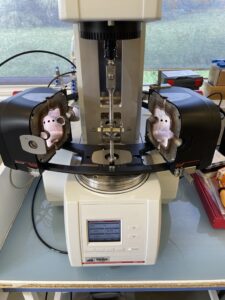
- mechanical: modules, mechanical strength, fatigue and impact resistance
- thermal: operating temperature range, fire resistance, dimensional stability
- physico-chemical: ageing, moisture absorption, fiber/resin compatibility
- behavior under natural or accelerated conditions
For example, for boat foils subject to immense loads, without precise analysis of the fiber/resin coupling, a foil can lose performance, crack or even break in use.
a key lever to adjust formulation and control processes
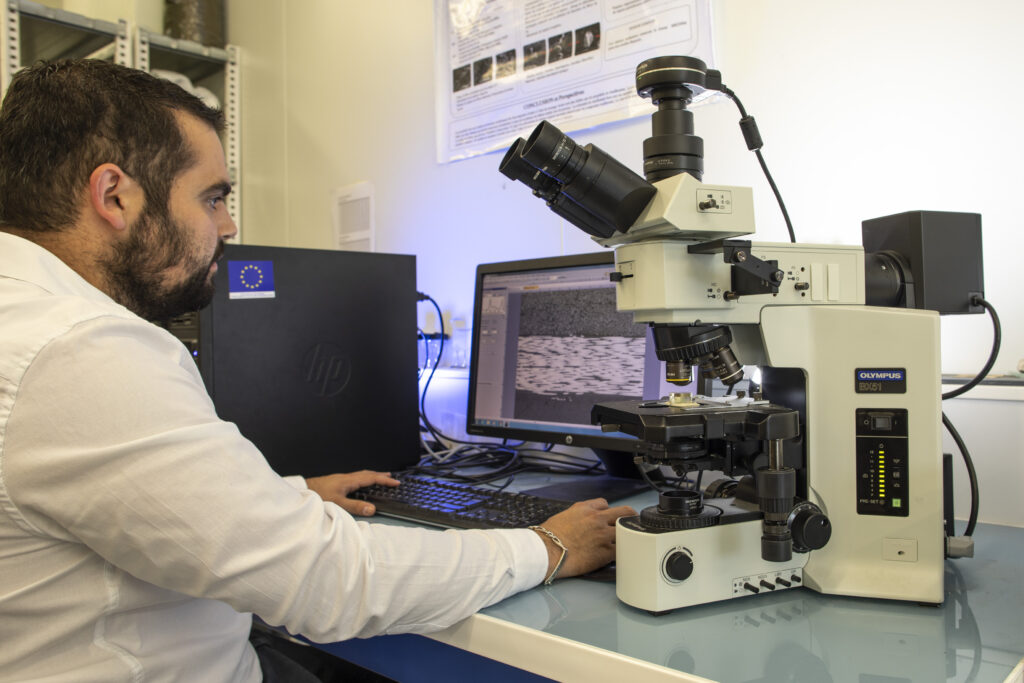
Characterization at different scales (microscopic to macroscopic) enables strategic decisions, including:
- adjusting formulations (biosourced resins or alternatives, new fibers, functional additives)
- validating material/process compatibility (infusion, molding, resin transfer molding, filament winding)
- securing industrialization through reproducible protocols
For pressure vessels, for instance, a poor material qualification can lead to weaknesses, delamination… or even explosions.
reduce environmental impact and support eco-design
Regulations are evolving, and governments are requiring more responsible production. Through characterization, companies can:
- develop eco-designed, well documented and traceable materials optimized for their life cycle
- scientifically justify environmental gains (lightweighting, durability, recyclability)
- reduce excessive material consumption by understanding real performance
- validate the integration of biosourced or recycled materials
- support compliance with regulatory requirements
Eco-design is therefore not just a goal—it is a logical extension of material mastery.
evolve processes and encourage automation
A well-characterized structure also enables reimagining manufacturing methods:
- optimizing process parameters (temperature, pressure, production rate)
- automating thanks to reproducible material data
- adapting layups to minimize waste, reinforcements or weak zones
- increasing industrial maturity (repeatability & reliability)
Characterization becomes the technical foundation for industrial scale-up.
ensure production quality with real-time control
Characterization also means in-process control:
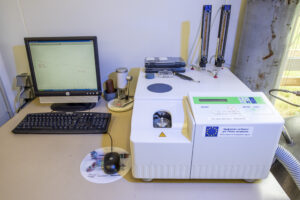
- measuring characteristic temperatures (Tg, Tf, polymerization) to ensure material suitability over a temperature range
- checking layup plans and fiber orientations
- evaluating material health: porosity, resin shortages, stacking errors
These steps ensure final product reliability and reduce costly quality failures.
how characterization drives innovation?
Characterization is a driver of competitiveness and project acceleration. It:
- facilitates development of new composite solutions that are lighter, more durable and easier to manufacture
- opens the door to innovative applications: competitive sailing foils, wind-powered cargo vessels, hydrogen tanks, complex structural parts
- supports partners’ developments across naval, marine energy, aerospace, defense, automotive, civil engineering, and composite manufacturing with reliable, reproducible data
Thanks to this approach, UBSIDE supports clients from prototype to industrialization, reconciling performance, responsibility, safety and sustainable innovation.