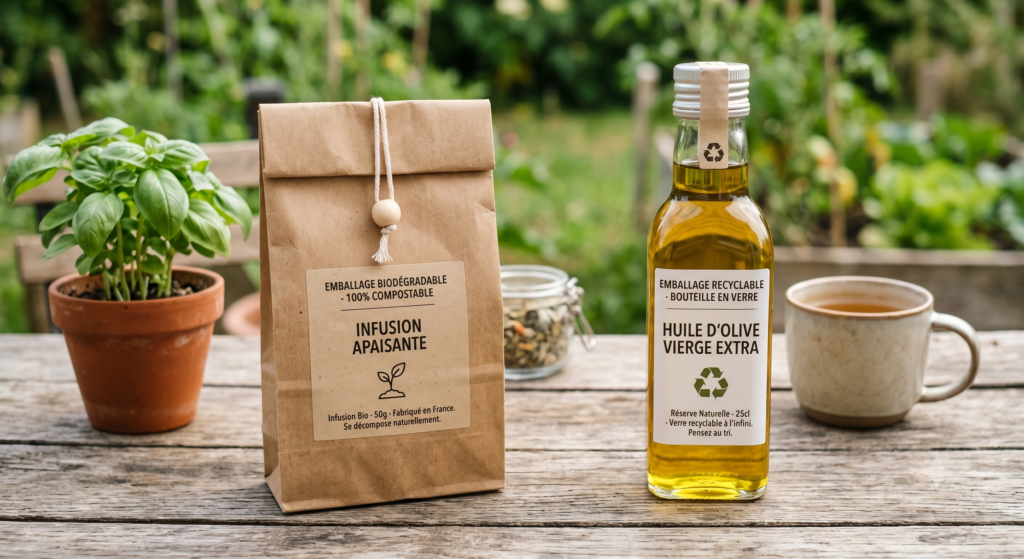
The industrial packaging sector is undergoing a profound legislative restructuring phase. While corporate environmental strategies frequently turned to biodegradable packaging to meet societal expectations, the European regulatory framework is now redefining priorities. The adoption of the PPWR (Packaging and Packaging Waste Regulation) redefines the rules of the game within the single market. Adopted in 2024 and applicable progressively until 2030, this regulation imposes a compliance timeline that manufacturers must anticipate starting today.
The European Union is now directing its strategy toward mechanical recycling and closed-loop circular economy practices. This shift profoundly alters development prospects for biodegradable packaging by restricting its use to highly specific applications.
What are the actual implications of the PPWR for packaging designers? Why is recycling becoming the dominant industrial standard at the expense of biodegradability? How does UBSIDE support manufacturers in bringing their packaging portfolios into compliance? Let us delve into the technical and operational facts of this transition.
The PPWR Regulation: The technical choice of recycling
The text of the PPWR harmonizes national legislations across Europe. Its primary objective is to reduce the volume of packaging waste and establish standardized recovery streams.
The industrial limitations of global biodegradability
Life cycle assessments (LCAs) conducted by European authorities highlight several technical constraints associated with the widespread adoption of biodegradable packaging:
- Lack of dedicated infrastructure: Collection networks and industrial composting facilities remain insufficient to absorb mass volumes.
- Disruption of sorting streams: The accidental introduction of biodegradable polymers (such as PLA) into traditional recycling streams (PET or PE) degrades the quality of the final recycled material.
- Behavioral challenges: The term “biodegradable” sometimes causes sorting errors by the end consumer, increasing the risk of littering in the environment.
To overcome these difficulties, European legislators favor material circularity.
The material must be kept within the economic circuit through recycling, thereby limiting biological recovery strictly to cases where recycling proves impossible.
The restricted scope of application for biodegradable packaging
The PPWR regulation does not completely eliminate biodegradable solutions, but it defines a current list of specific applications for which end-of-life under industrial composting conditions remains mandatory. This list is subject to change through regulatory revisions.
Les exceptions réglementées
The legislation reserves the use of biodegradability and compostability criteria for the following products:
- Tea and herbal tea bags.
- Disposable coffee capsules and pods, due to the high proportion of organic matter (coffee grounds) adhering to the packaging after use.
- Adhesive labels affixed directly to fruits and vegetables.
- Very lightweight plastic carrier bags intended for transporting loose bulk food items.
The return to standard recyclable materials
Outside of these four exceptions, using biodegradable packaging is no longer a priority pathway according to the European regulatory hierarchy. For bottles, flasks, wrapping films, trays, and transport packaging, the industry is directed toward traditional, highly recyclable polymers: polyethylene (PE), polypropylene (PP), PET, as well as cardboard and glass.
Operational challenges linked to widespread recycling
The transition toward 100% recyclable packaging involves significant adjustments for production managers and packaging engineers.
Post-consumer recycled (PCR) material management
The obligation to integrate recycled plastic, particularly in the food and cosmetics sectors, raises the challenge of food-contact compliance—a challenge governed by Regulation (EU) No 10/2011. Manufacturers must collaborate with suppliers capable of guaranteeing material purity and batch homogeneity to ensure consistent mechanical properties.
Adjusting Machine Parameters
Recycled plastics exhibit slightly different thermal behaviors and viscosities compared to virgin materials. Processing these materials on bagging machines, thermoforming lines, or bottling lines may require fine-tuning (sealing temperature, pressure, cycle time) to maintain industrial throughput. However, when incorporation rates of recycled material remain moderate, these variations are generally limited, and their impact on processing parameters often remains negligible.
UBSIDE: Your technical partner for a successful transition to recyclable packaging
In this context of regulatory shift imposed by the PPWR, UBSIDE, in close collaboration with its partner platform ComposiTIC, provides you with advanced expertise and pre-industrial equipment to secure your packaging compliance.
Regulatory audit and comprehensive recyclability study
UBSIDE engineers analyze your current packaging portfolio. If your processes incorporate biodegradable packaging that does not meet the exception criteria of the new European legislation, we qualify replacement solutions. We conduct a complete stream study to validate the new material’s capacity to be collected, sorted, and processed sustainably.
Custom formulation and recycled material integration
Returning to standard plastics requires perfect mastery of formulation to maintain the barrier and mechanical properties necessary to protect your products. UBSIDE and ComposiTIC design custom plastic formulations. Using advanced characterization resources, our teams accurately evaluate viscosities, material degradation, and changes in macromolecular chain size, ensuring consistent quality of the final material.
Real-condition testing on our technical platform
Modifying a packaging material must not impact your factories’ productivity. UBSIDE grants you access to a complete recycling line and pre-industrial scale processing equipment to test your solutions under conditions close to your production reality:
- Mechanical Processing: Feasibility trials for the processing, shredding (parts up to 50 x 50 cm), and grinding (calibration grids from 4 to 12 mm) of your scrap or end-of-life packaging.
- Regeneration: Utilization of a single-screw compounding extruder (heating temperature up to 400°C) to convert ground material into reusable pellets.
- Processing Application: Reutilization tests of new recycled or reformulated materials on dedicated machinery (injection molding presses, extruders compatible with engineering thermoplastics).
- Material Characterization: Analysis of the physicochemical, thermal, rheological, and mechanical properties of materials before and after recycling (FTIR, DSC, MFI, tensile, flexural, impact testing) to evaluate their behavior and reuse potential. The results can be synthesized into a material technical data sheet compiling the primary characteristics of the recycled or reformulated material.
Industrial equipment recommendations
Beyond laboratory trials, UBSIDE accompanies you through to the industrialization of your circularity approach. Our experts leverage pilot test results to recommend the investments and industrial equipment best suited to your volumes, materials, and plastics processing methods.
Stabilizing your packaging investments with UBSIDE
The European Union’s choice in favor of industrial recycling redefines the future of biodegradable packaging. This regulatory clarification provides a stable framework for companies to direct their R&D investments toward robust and sustainable mechanical circularity technologies.
In summary, the PPWR does not erase the environmental value of biodegradability; it circumscribes its legitimate scope of application. For manufacturers, this means that a large majority of packaging must now be redesigned around mechanical recycling streams, with strict requirements regarding formulation, material traceability, and performance under regulated contact conditions.
Compliance with the PPWR regulation requires a dual competence in materials science and industrial process management. UBSIDE delivers the essential technical expertise to secure your packaging, de-risk your packaging lines, and guarantee your products’ access to the European market.
Contact the UBSIDE teams to perform a regulatory audit of your packaging and steer your transition projects toward the circular economy.