The preservation of marine ecosystems has become one of the major challenges of our century. Faced with increasing human pressures on the oceans, the scientific community, public institutions, and stakeholders in the fishing industry are joining forces to develop concrete and sustainable solutions. It is precisely within this dynamic of transition and technological innovation that the CARAMBAR project (CARActerisation & Minimization of fishing gear impact: the case study of the Bay of Biscay, the French Antilles, and St. Pierre) is situated.
This research and innovation project addresses an environmental issue: the impact of fishing gear lost or abandoned at sea. By focusing on two types of operations, optimizing the selectivity of fishing gear will help reduce bycatch in fish traps. The applied research will focus in particular on citizen science, underwater imaging for the detection of lost gear, and the development of artificial bait and biodegradable fishing line.
Led by a multidisciplinary consortium of leading stakeholders, the CARAMBAR project receives financial support through the Research & Innovation component of the FEAMPA (European Maritime, Fisheries, and Aquaculture Fund), a program managed by the Brittany Region to mitigate the impact of fishing on the marine environment.
To successfully carry out this ambitious program, the consortium brings together complementary areas of expertise:
- Ifremer (French Research Institute for Exploitation of the Sea) in Lorient, which provides cutting-edge scientific expertise in marine technologies.
- UBSIDE, an innovative company specializing in materials engineering and R&D support.
- Asso-Mer, an organization dedicated to marine conservation and raising awareness.
- The Regional Committee for Marine Fisheries and Aquaculture in Brittany (CRPMEM), which serves as a direct link to on-the-ground realities and maritime professionals.
- The Finistère Departmental Committee for Marine Fisheries and Aquaculture (CDPMEM), a key local player in local experimentation.
- The National Museum of Natural History (MNHN) – Concarneau Station, which offers a historical and biological perspective on the evolution of marine biodiversity.
I. Mapping and citizen science: The two pillars of the CARAMBAR project
To effectively address the issue of lost fishing gear, the CARAMBAR project is implementing a comprehensive scientific strategy centered on two complementary areas of research and development: the precise characterization of the problem in the field, followed by the minimization of risks at the source through technical innovation.
Mapping lost vessels using AI and autonomous underwater vehicles (AUVs)
It is estimated that thousands of tons of fishing gear (nets, traps, lines) are lost worldwide each year as a result of storms, collisions with merchant ships, or becoming snagged on the seabed. To address this problem, we must first know where it lies. The primary focus of the CARAMBAR project is therefore to locate, characterize, and map this gear across three key geographic areas, selected for the diversity of their environmental, hydrodynamic, and cultural characteristics: Martinique, the Bay of Biscay, and Saint Pierre and Miquelon.
This mapping initiative is based on a unique technological synergy. On the one hand, the project draws on citizen science, engaging professional fishermen, divers, and other marine users to collect field data. On the other hand, this data is combined with cutting-edge technologies: artificial intelligence (AI) for image and signal processing, as well as the deployment of an autonomous underwater vehicle (AUV). Capable of scanning the seabed with millimeter-level precision, the AUV helps identify areas where fishing gear has accumulated.
Removal procedures and selective measures to minimize impact
The second focus of the project aims to reduce the environmental impact of lost fishing gear by locating and then removing marine macro-debris. Once the gear has been identified, the consortium will rely on a network of trained personnel to organize safe recovery operations, while minimizing disruption to sensitive benthic habitats such as seagrass beds and reefs.
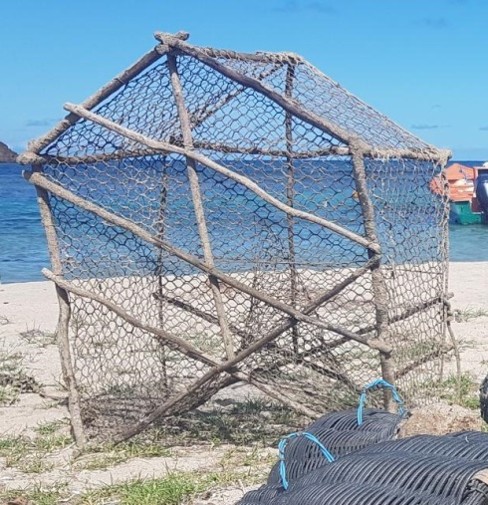
At the same time, the CARAMBAR project aims to reduce ghost fishing and bycatch through the development of innovative devices designed for fish traps. In particular, selective escape windows will be studied to allow the release of undersized fish and preserve fish stocks. The project is also focused on developing alternative solutions to limit the use of natural resources for baiting fishing gear, thereby helping to reduce the overall ecological footprint of fishing activities.
Eco-design of materials for the marine environment: UBSIDE’s involvement
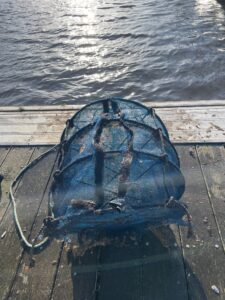
Within this large organization, UBSIDE plays a pivotal role in Work Package 2, which is entirely dedicated to minimizing the impact of fishing activities on the marine environment. Drawing on its expertise in formulation, biodegradation and biodegradability, and materials characterization, our team is involved in three major areas of technological development:
- Reducing ghost fishing: This tragic phenomenon occurs when lost fishing gear continues to trap fish, crustaceans, and marine mammals indefinitely. To address this, UBSIDE is developing biodegradable filaments for use in the assembly of certain fishing gear. If lost, the filament breaks after a certain period of time, opening the net or trap and releasing the trapped animals.
- The Development of Biodegradable Baits: Traditionally, baiting techniques require large quantities of wild fish. UBSIDE is exploring an innovative alternative by designing eco-friendly synthetic baits made from water-soluble plastics that can release attractants in a controlled manner before dissolving completely without leaving any toxic residues.
- The Design of Biodegradable Fish Traps: Beyond individual components, UBSIDE is conducting an in-depth study on the eco-design of a fully biodegradable fish trap structure capable of maintaining its mechanical properties throughout its commercial lifespan and then breaking down naturally if it is abandoned or lost at sea.
II. The Effect of Environmental Conditions on the Degradation of Monofilaments
a. Study conditions
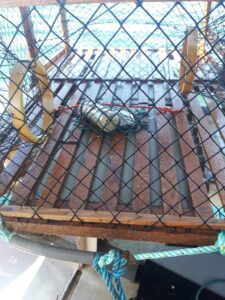 Current research focuses primarily on studying the behavior and aging of biodegradable monofilaments under natural conditions. To assess the influence of environmental parameters on degradation mechanisms, comparative immersion tests have been conducted at three sites with contrasting climatic and oceanographic conditions:
- The Bay of Biscay (Lorient, Brittany): Characterized by a temperate climate, marked seasonal variations, and nutrient-rich waters.
- Robert Bay (Martinique): A tropical ecosystem characterized by warm waters, high UV radiation, and extremely intense biological activity (bacteria, microorganisms, and biofouling).
- Saint Pierre and Miquelon: A polar environment characterized by very cold waters, harsh weather conditions, and slower biological processes.
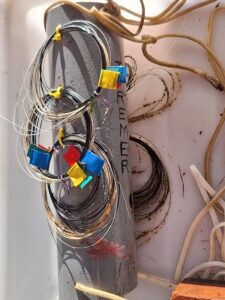
In total, four formulations composed of different biodegradable polymers were submerged in the form of monofilaments. Regular sampling is conducted by our on-site partners to send us filament samples. The UBSIDE team then performs two types of laboratory characterization: tensile testing to measure changes in mechanical properties (breaking strength, ductility) and microscopic observations to analyze the surface condition.
b. First results
The data collected and analyzed by UBSIDE engineers provide a better understanding of how biodegradable polymers behave when submerged in the marine environment under real-world conditions. The results highlight varying degradation kinetics that are highly dependent on local environmental parameters such as temperature and biological activity.
Analysis after 1 month of immersion: The first signs of divergence
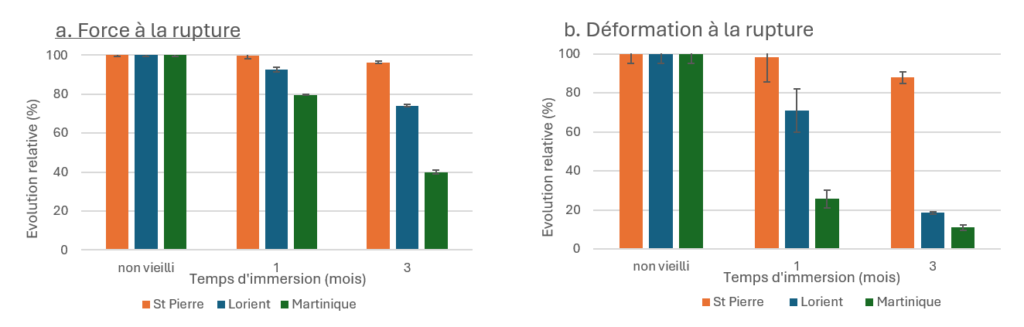
The results presented highlight how the mechanical properties of the monofilaments change depending on the immersion time and the location of exposure: temperate water (Brittany), warm water (Martinique), and cold water (Saint Pierre and Miquelon).
After one month of immersion, differences began to emerge among the sites. The tensile strength decreased slightly for the sample exposed in Martinique, while it remained stable for those in Lorient and Saint-Pierre. At the same time, the elongation at break dropped sharply in Martinique, indicating a rapid loss of ductility, whereas it decreased more moderately in Lorient and remained generally stable in Saint-Pierre.
Analysis after 3 months of immersion: A marked acceleration in the kinetics
After three months, these trends have been confirmed and have become more pronounced. The sample from Martinique shows significant degradation, with a marked decrease in tensile strength and very low deformation, indicating that the material has become brittle and fragile. In Lorient, the degradation is moderate, with a noticeable but less pronounced decrease in mechanical properties. In contrast, the sample from Saint-Pierre maintains relatively high performance, particularly in terms of elongation at break, indicating greater material stability in this environment. The next sampling is scheduled after 6 months of immersion.
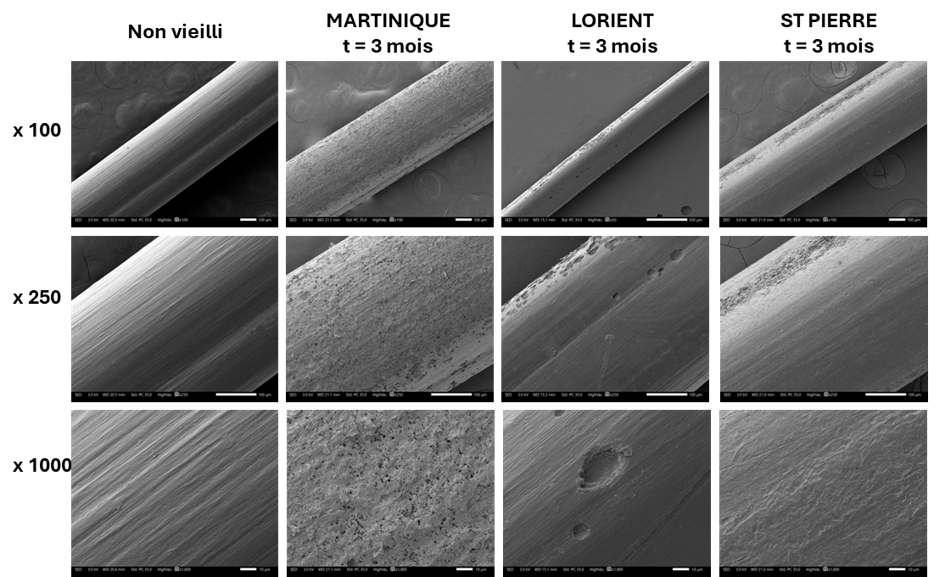
Under the microscope: These mechanical observations are consistent with the microscopic analyses, which reveal more pronounced surface changes and signs of degradation in the samples exposed to tropical conditions.
High-resolution SEM images show that the monofilaments submerged in Martinique exhibit surface irregularities, including the formation of pores, whereas the filaments from Saint-Pierre retain a smooth and uniform surface.
III. The next Steps with UBSIDE
The initial results obtained as part of the CARAMBAR project confirm that the aging and biodegradation of these materials in the marine environment result from complex interactions with their surroundings. The degradation kinetics observed are not linear and depend heavily on local exposure conditions, particularly water temperature and biological activity.
Overall, the tests reveal significant differences among the sites studied. Degradation appears to occur particularly rapidly in tropical environments (Martinique), likely due to the combined effect of higher temperatures and greater biological activity. Conversely, it is more limited or slowed in colder marine environments. These results underscore the importance of taking actual usage conditions into account in the design and evaluation of biodegradable materials intended for marine applications. Additional temperature monitoring is also being conducted at each site to refine the interpretation of the observed phenomena.
UBSIDE engineers are currently continuing to monitor the materials under real-world conditions. The next step will involve analyzing samples collected after six months of immersion in order to build on the knowledge gained regarding the behavior of biomaterials in the marine environment and to support the development of solutions tailored to the needs of the fishing industry.
The CARAMBAR project receives financial support from the Brittany Region.